Hobbits™
Tolkien did not pull this name out of thin air. Did Michael Denham?

I am not your attorney, and no part of this article should be construed as legal advice.
Were you aware that the name Hobbit™ has been trademarked? It’s kind of crazy that both Middle Earth Enterprises and Warner Brothers might sue you for trademark infringement if you use the name Hobbit™ in some way they deem unacceptable. But property rights have always been a bundle of sticks, and when you unbundle them, you end up with multiple people who can beat you senseless.
Copyright is, of course, a separate concept also designed to protect intellectual property and reward creators. Thus the Tolkien estate, also, might be at your door like an angry Balrog™. (Incidentally, were you aware that Capcom owns the trademark on Balrog™ in the context of video games due to their Street Fighter series?)
This is why in Dragons Beyond you’ll see that I use the accepted shorthand for a Hobbit™ — the name Halfling. Some folks get around intellectual property (IP) rules by using the spelling Haelfling which has the distinction of looking like Old English (Chivalry & Sorcery for example). In Dragons Beyond and Midwest Fantasy Wargame: The Primeval RPG I also use the term Bealuwearg instead of Balrog™. This word has a few Old English meanings, and you can read more about them at the links below:
In a similar way, I use Vargr instead of Worg in Midwest Fantasy Wargame, and also use Giant Wourme instead of Purple worm. I prefer these older, Germanic/Scandinavian rooted words because they potentially avoid copyright claims, but also they seem to evoke something in my core. Perhaps we truly do have ancestral memories (Carl Jung’s Red Book), genetic coding (Frank Herbert’s Dune), or some underlying operating system (Neal Stephenson’s Snow Crash).
So anyway, I was skimming through my rather large collection of pdfs yesterday. This included Tom Moldvay’s The Challenge Game System® from 1986. On page 5, you can see a note on the origins of the word Hobbit.
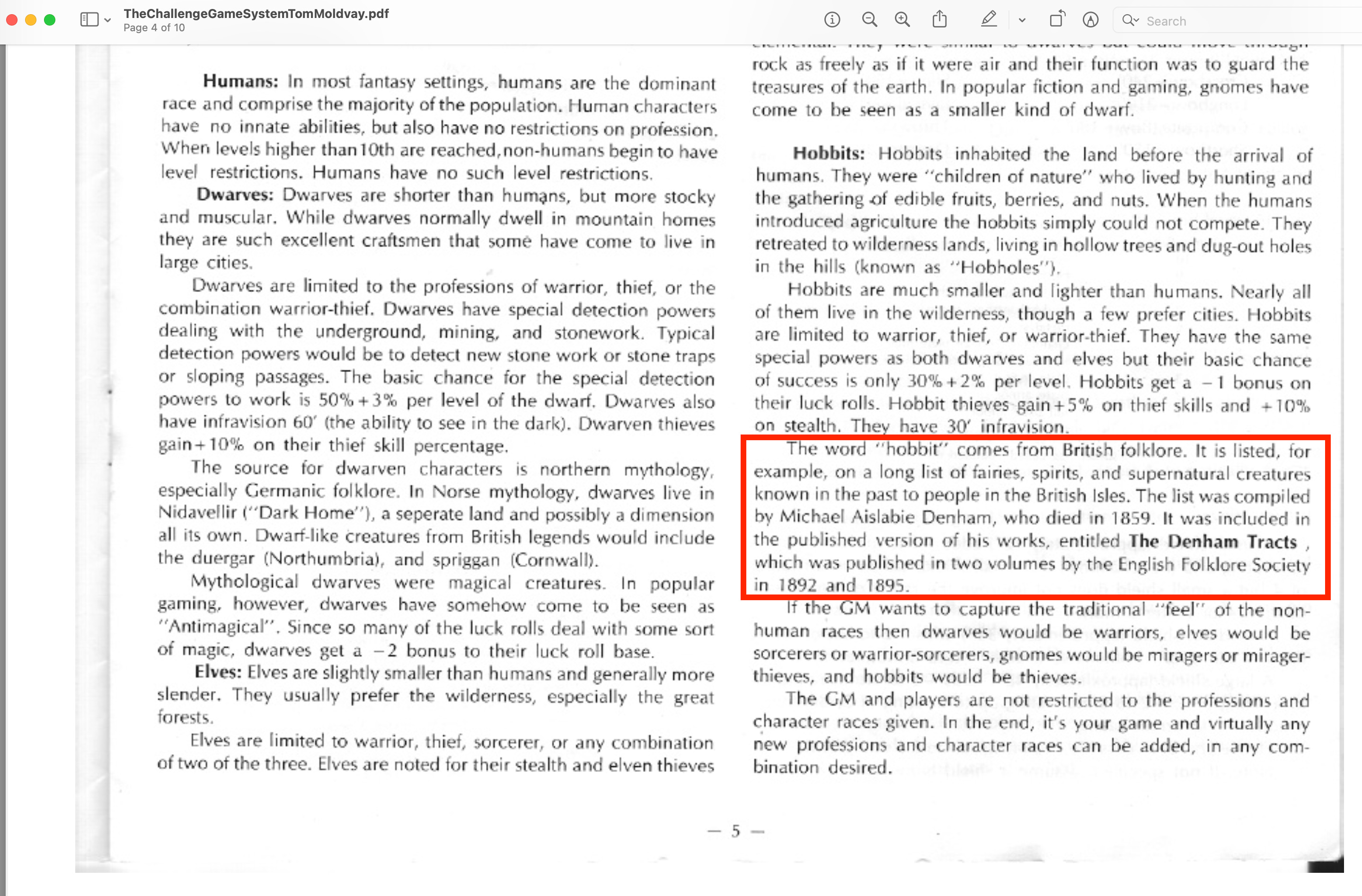
This is the kind of rabbit hole that I cannot resist exploring. So off I went in search of the Denham Tracts. Wikipedia had an entry and there were a handful of scans on archive.org. Eventually, I found what I was looking for in Volume II on page 79. Since these tracts date back to the late 1800s, it is clear that the word “Hobbit” standing alone as a type of fantastic creature is outside of copyright. However, how you describe such a creature could quickly become troublesome if the description hews too closely to Tolkien’s characters.


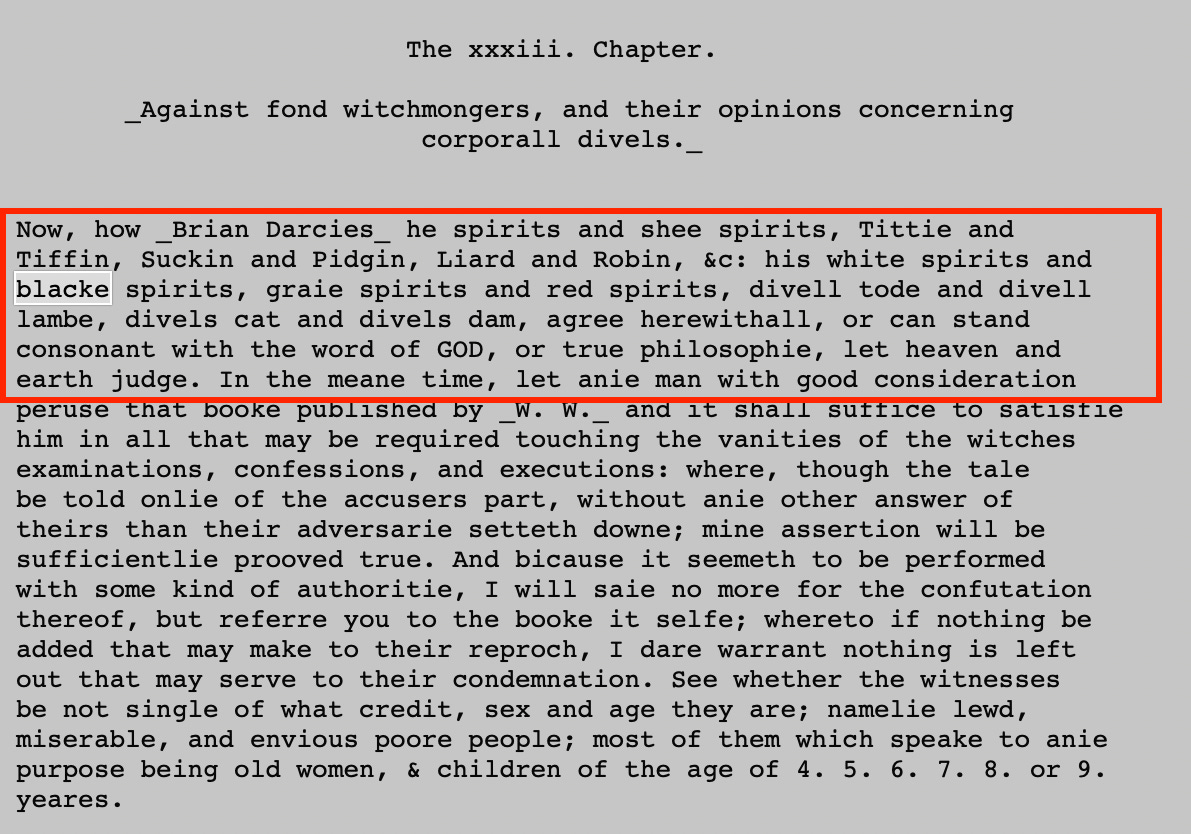
But, taking it a step further, I wanted to know where Denham dug up this word. The list of creatures cited by Denham was probably sourced from the Discoverie of Witchcraft (as this excerpt from the wikipedia page states). I did some digging, but it is true that the trail mostly goes cold after that.

First, I found two copies of the Discoverie of Witchcraft (Reginald Scot, 1584) which is, as it turns out, probably the source for a large chunk of the common knowledge about occult practices and grimoires cited by many modern Wiccans and ritual magicians. The list comes from Book 7, Chapter 15. The earlier version of the book is in gothic script and may be harder for some readers to understand. The later version is very easy to read.


There is a shorter list, also in Discoverie of Witchcraft, that does not seem to relate back to the Denham tracts. Still, if anyone is accumulating their own list of fantastic monsters this is further fodder.
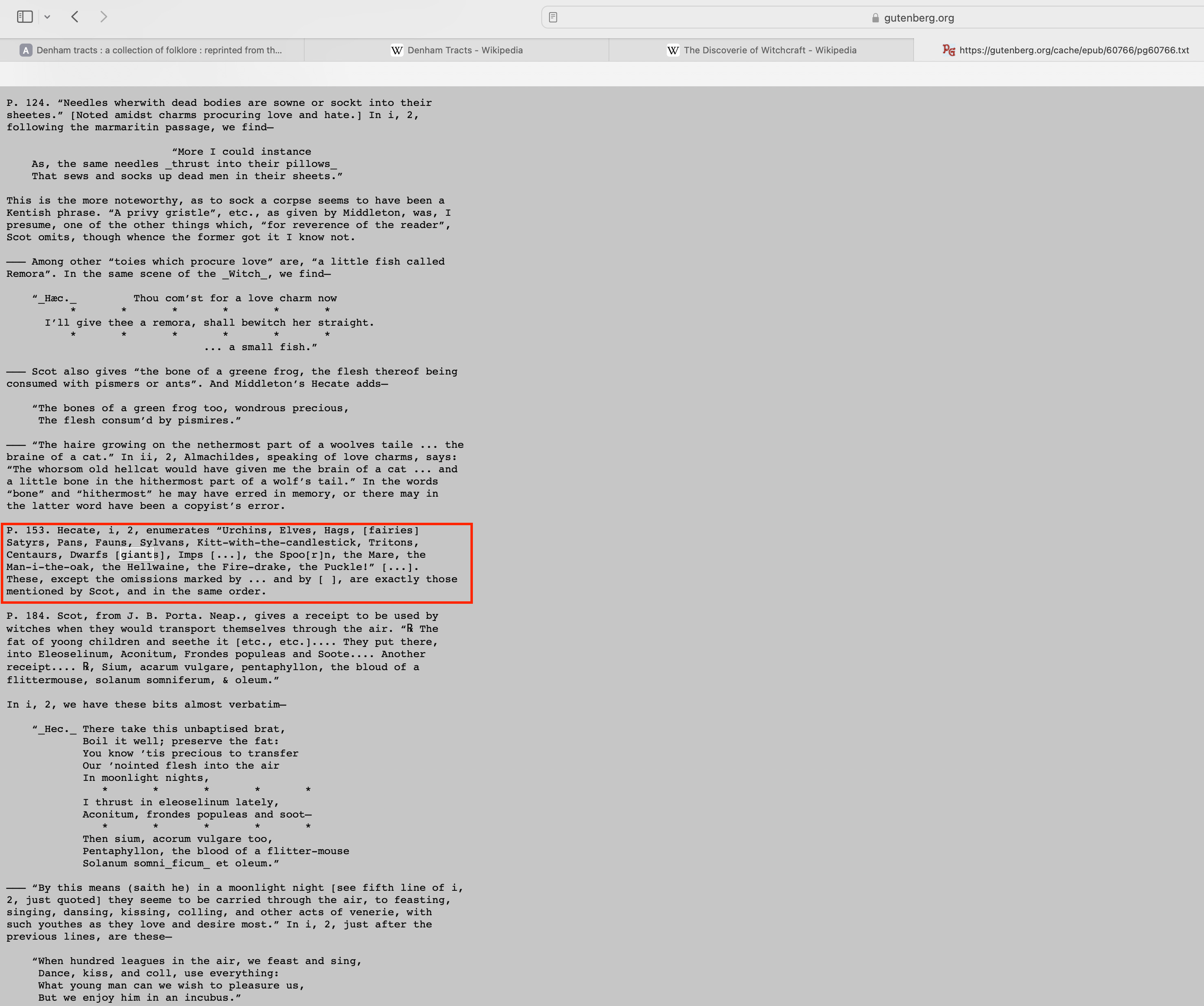
There are other books and plays from the late 1500s to 1600s that also touch on witchcraft and have shorter lists that are tangentially related to the list in the Denham tracts. For example, the character Hecate in Thomas Middleton’s The Witch (c. 1613) Act I, Scene 2 has this list: "Urchins, elves, hags, satyrs, pans, fawns, silens, kit with the candlestick, tritons, centaurs, dwarfs, imps, the spoorn, the mare, the man i' th' oak, the hellwain, the firedrake, the puckle!" Cross-referencing with Reginald Scot's list, you can spot direct matches: urchins, elves, satyrs, pans, fauns, tritons, centaurs, dwarfs, imps, the spoorn (spoorns), the man i' th' oak (men-in-the-oak), the hellwain (hell-wains), the firedrake (fire-drakes), and the puckle (puckles). "Kit with the candlestick" maps to "kit-a-can-sticks" in Scot. Incidentally, The Witch seems to be a solid tale worth checking out. It is also available on Project Gutenburg where the footnotes describe further connections to Scot’s Discoverie of Witchcraft.
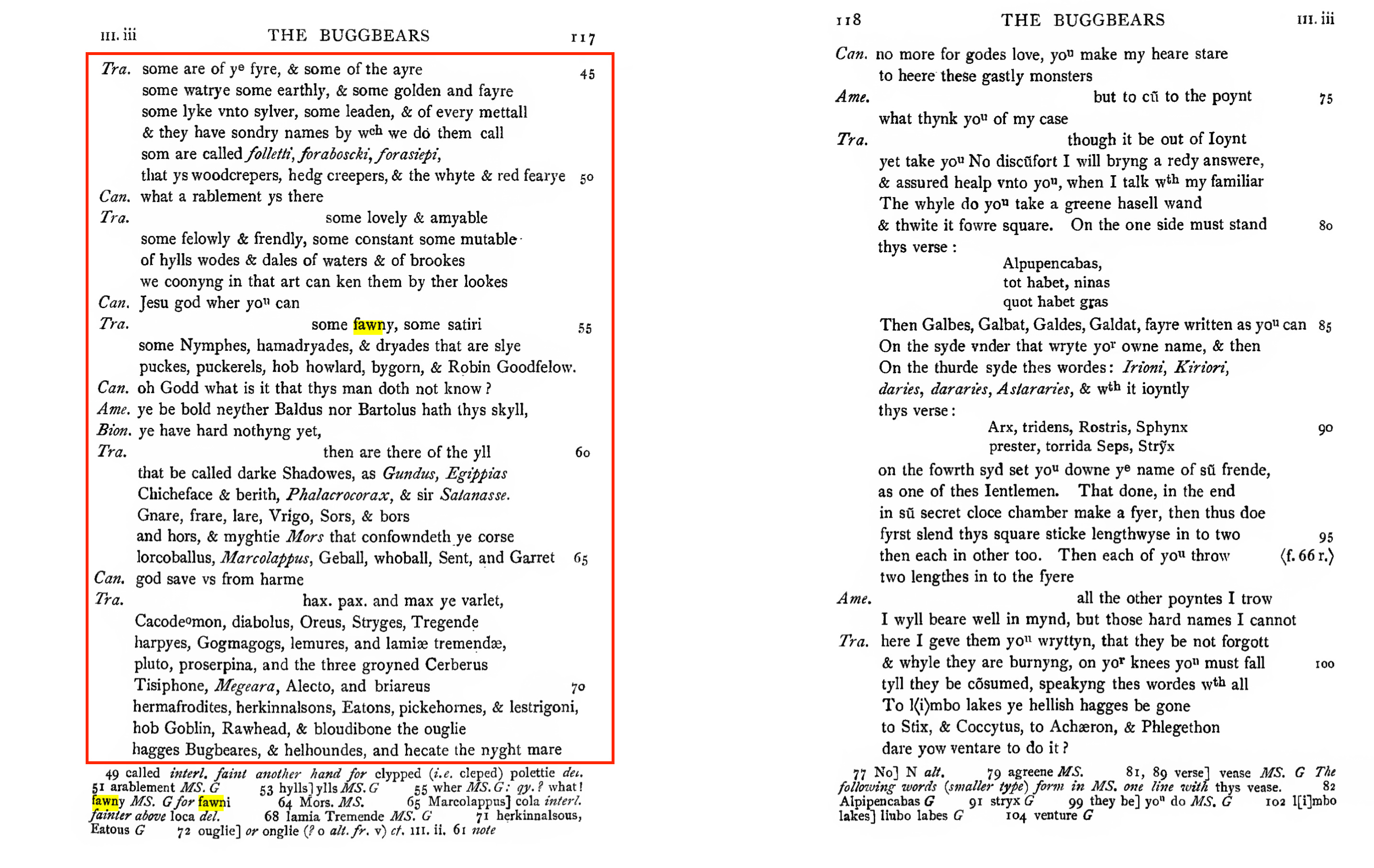
The final reference worth checking out is The Buggbears (by John Jeffere, c.1563-65). What makes this notable is that it predates Discoverie of Witchcraft by about two decades. This play is within R. Warwick Bond’s scholarly collection Early Plays from the Italian (1911), which can be found here: https://archive.org/details/cu31924013324110.
And what of this Robin Goodfelow? Well, he is another trickster. You may recall a reference to this being another name for Puck in Shakespeare’s A Midsummer Nights Dream. But to get a better handle on all of his tricky ways, check out the popular pamphlet called Robin Good-Fellow, His Mad Prankes and Merry Jests, published in 1628. It is also available on archive.org though this is (J. Payne Collier’s 1841 Percy Society reprint of the 1628 edition. https://archive.org/details/madpranksmerryje00colluoft
So where does that leave us with our friend the Hobbit™? Clearly he is not the invention of Tolkien alone. Is a Hobbit™ simply another type of frightening “bug” just a comma away from a hobgobin or a grant? Is he a faerie trickster like Robin Good-fellow? Or is he something else entirely, some form of spirit or dwarf? One thing is for sure, if he is ill-used in your writing, you can expect to be ill-used in return.
This is a post worth tobe read by any fantasy enthusiast. If I may add, by reading that short text from the discoverie of witchcraft, I have the suspect that there could be a link between the Tom thombe and Tom Bombadil as well ... thanks for the great reasearch and may the fun be always at your table!